
by Julian Xanthi
In an age where much of contemporary photography leans into polished conceptualism or post-produced spectacle, it is startling to encounter an image that bites — not with irony, but with blood, soil, and myth. The portrait of Nedim — a young boy crouched at the edge of a forested wetland, bare to the elements, eyes fixed somewhere between fear and defiance — demands we revisit an older kind of narrative. One rooted in ritual, exile, and transformation.
Inspired by an Anatolian legend in which boys come of age by slaughtering wolf cubs — a brutal covenant with their ancestors — this work does not glorify the tradition. Instead, it asks: What if one refuses? Nedim, the boy in question, turns his back on the village ritual and vanishes into the forest. This image captures the moment after that decision — when myth ceases to be story and becomes skin.
The composition is deceptively simple. Nedim crouches low, like an animal sensing its first winter. His posture blurs the line between hunter and hunted — evoking classical depictions of Enkidu or Romulus, those archetypal feral sons. A fallen tree diagonally frames the upper half of the image, drawing a sharp visual line that parallels the curvature of Nedim’s spine. This resonance between body and landscape is no accident — it visually inscribes him into the wilderness he has chosen, or perhaps, that has chosen him.
Lighting plays a pivotal role. The use of chiaroscuro, reminiscent of Caravaggio, isolates Nedim’s face and shoulders in a luminous cut of cold light. His skin, marked with scratches — not stylized, but real, stinging — glows against the somber backdrop of a shadowed swamp. The forest is not romanticized; it is damp, layered with decay, thick with the quiet violence of growth. Behind him, a still pool reflects a tangle of barren branches, suggesting a mirror to the subconscious, a threshold into something older than language.
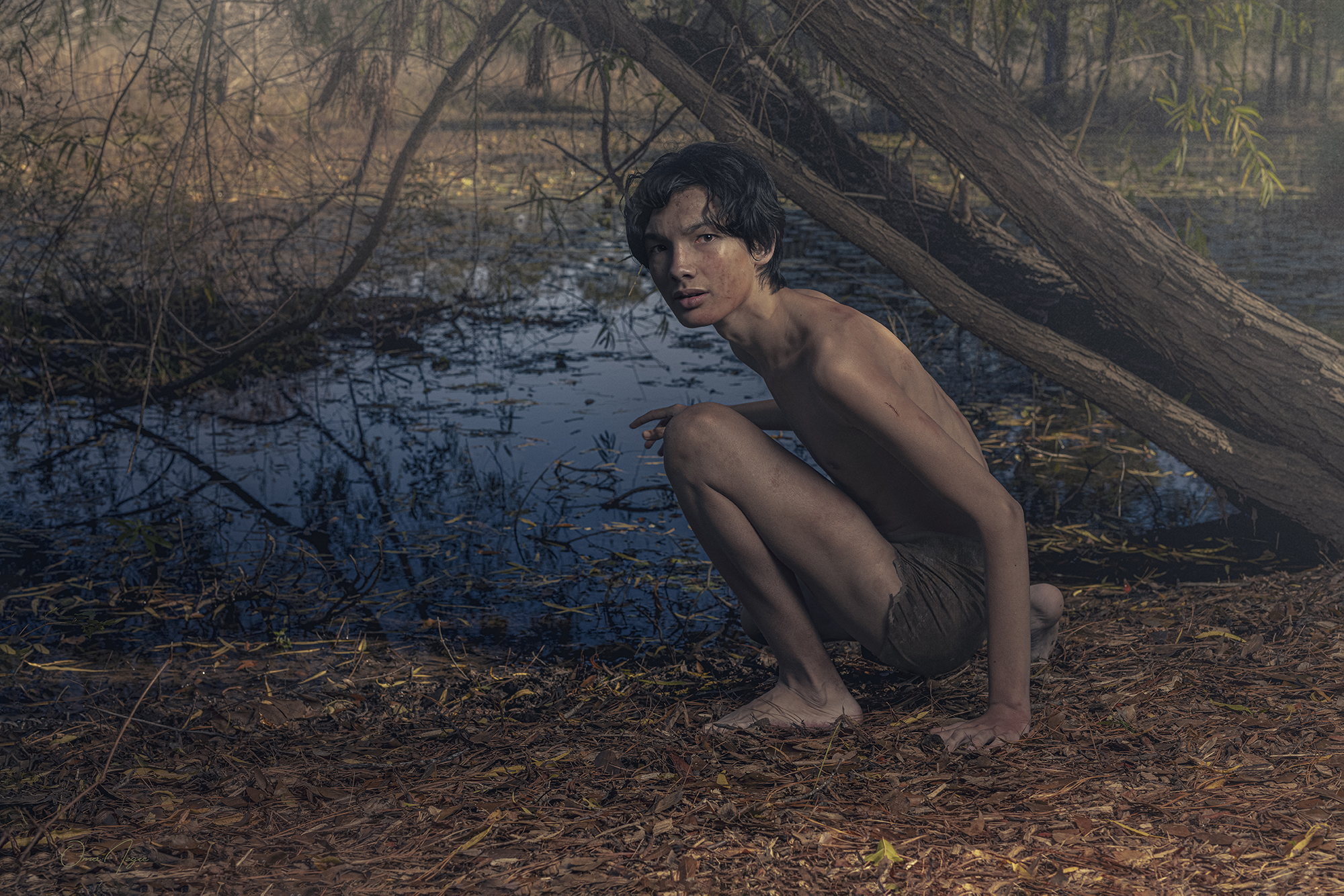
And then there is the expression — a face half-wild, half-human. It does not perform for the viewer. Instead, it studies us. There is no triumph, no tragedy. Only a haunted stillness. These are not the eyes of a boy who has simply run away. These are the eyes of one who has stepped out of a story and into the jaws of something sacred.
In resisting the rite of violence, Nedim enacts a deeper, more dangerous ritual: the rejection of inherited bloodlust. And the photograph refuses to resolve his fate. It does not ask us to pity him or follow him. It merely bears witness to the unmaking — or remaking — of a boy.
This work is not a portrait in the traditional sense. It is a wound, offered with precision. A howl, caught in a breath. And in a time when cultural identity is often simplified into pride or shame, Nedim reminds us that true identity may lie elsewhere: in the lonely, luminous act of saying no.
 omerizgec.net